AI & product intelligence

Add AI where it creates measurable value

We help identify and build AI features that improve workflows, support users, analyze data, automate manual tasks, or create new product capabilities, with the security and data handling that fintech and other complex products require.

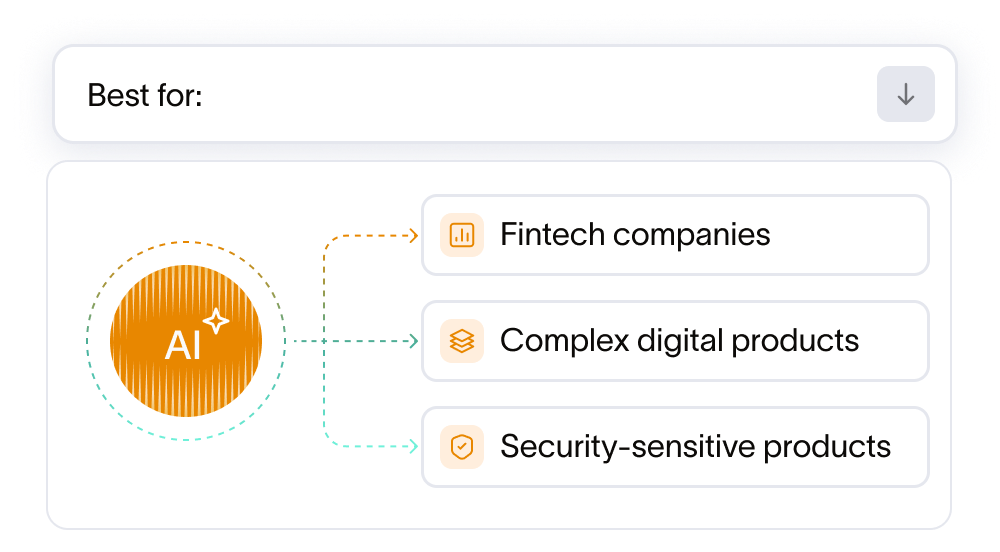
Mockup card showing who MVP development is best for: fintech startups, complex digital products, and early-stage founders

AI could help your product, but where is it worth it.

This is the right fit when AI could genuinely help, but you need evidence of where, before committing budget to build it.

Manual work is slowing the product down

Manual work is slowing the product down

Teams or users repeat tasks that could be supported or automated more effectively.

Data is hard to use, and users need smarter support

Data is hard to use, and users need smarter support

The product collects information, but users still struggle to find patterns or get the right guidance at the right moment.

AI ideas are disconnected from the roadmap

AI ideas are disconnected from the roadmap

Your team has several possibilities, but no clear way to compare their value, feasibility and risk.

The feature touches sensitive or regulated data

The feature touches sensitive or regulated data

Financial, personal or compliance-relevant data needs security review, access controls and, for fintech-grade features, third-party testing before it reaches production.

Start with the problem,
not the model

We evaluate each opportunity through user value, business impact, data readiness and technical feasibility before deciding what should be built.

01

User value

Does it solve a problem users actually have, or would a simpler rule-based feature do the same job without the added complexity and cost of AI?

02

Business impact

Does the expected outcome justify the ongoing cost of running it, such as model usage, latency, and the review or oversight it will need in production?

03

Data readiness

Is the underlying data structured enough to retrieve or query reliably, or does it need cleanup, labeling, or a retrieval layer before AI can use it accurately?

04

Technical feasibility

Can the feature meet the accuracy, speed and error tolerance the use case requires, and can we build in the right safeguards for when it gets things wrong?

01

User value

Does it solve a problem users actually have, or would a simpler rule-based feature do the same job without the added complexity and cost of AI?

02

Business impact

Does the expected outcome justify the ongoing cost of running it, such as model usage, latency, and the review or oversight it will need in production?

03

Data readiness

Is the underlying data structured enough to retrieve or query reliably, or does it need cleanup, labeling, or a retrieval layer before AI can use it accurately?

04

Technical feasibility

Can the feature meet the accuracy, speed and error tolerance the use case requires, and can we build in the right safeguards for when it gets things wrong?

Practical capabilities built into real product workflows

We design AI features around specific user needs, business goals and existing product workflows rather than treating AI as a separate experiment.

Workflow automation

AI agents complete multi-step tasks, such as pulling data, filling forms and triggering actions, rather than just flagging what to do next.

Intelligent assistance

Give users an assistant that understands their context and can help, not a static help menu.

Search and knowledge access

Let users ask questions in plain language and get answers from your own documents and data, not just keyword search.

Data analysis and insights

Turn product or usage data into plain-language answers, so teams don't need a dashboard for every new question.

Personalisation and recommendations

Adapt what users see or are offered, based on real behaviour and context, not a fixed rule set that treats everyone the same.

New product capabilities

Offer things that weren't possible before, like turning documents, conversations or messy data into something the product can act on.
Validate the value first. Then build for real usage.

We move from a focused product opportunity to a tested and integrated AI capability, with clear decisions at each stage.

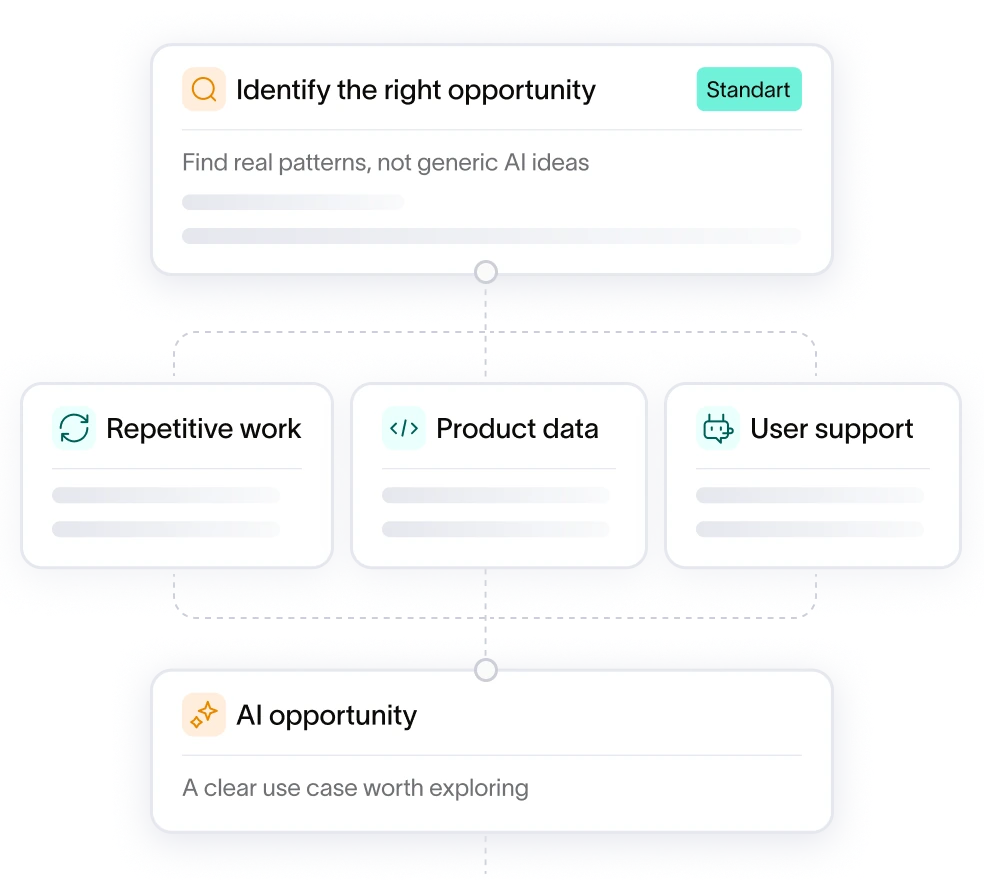
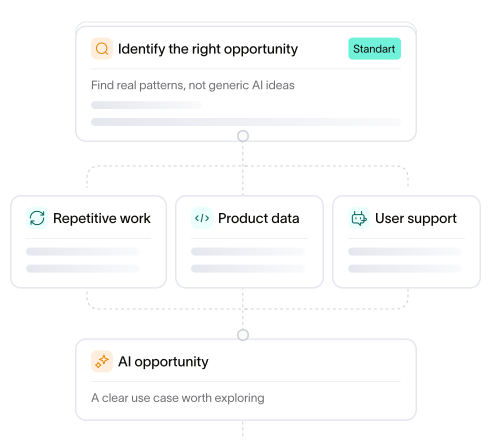
Identify the right opportunity

We look for repetitive manual work, unused product data, or moments where users need faster or smarter support: the same patterns that separate a real opportunity from a generic AI feature.

We look for

  • Repetitive manual work with a clear, learnable pattern
  • Product data that already exists but isn't being used
  • Moments where users visibly struggle or ask for help
Identify the right opportunity diagram: finding real patterns, not generic AI ideas — repetitive work, product data, and user support, leading to a clear AI opportunity

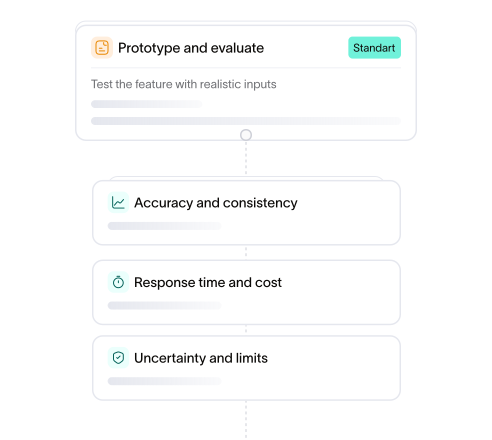
Prototype and evaluate

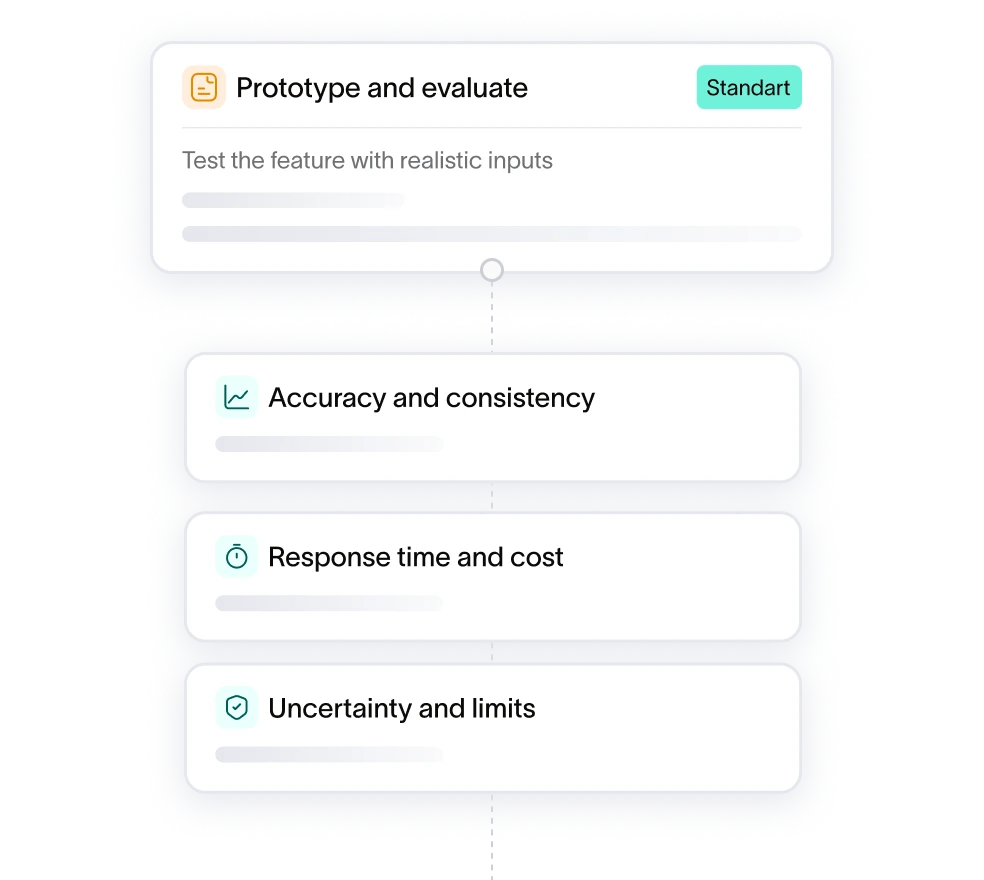
We build a working version and test it against realistic inputs, checking accuracy, latency, and how often and how badly it gets things wrong, not just whether it works in a demo.

We test

  • Accuracy and consistency across realistic inputs
  • Response time and cost at expected usage volume
  • How clearly the feature communicates uncertainty or limits
Prototype and evaluate diagram: testing the feature with realistic inputs — accuracy and consistency, response time and cost, and uncertainty and limits

Integrate and improve

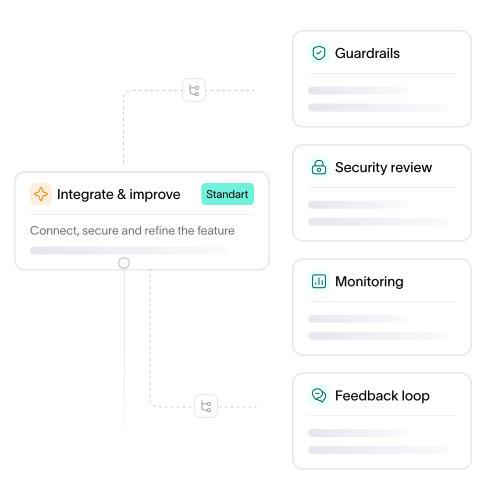
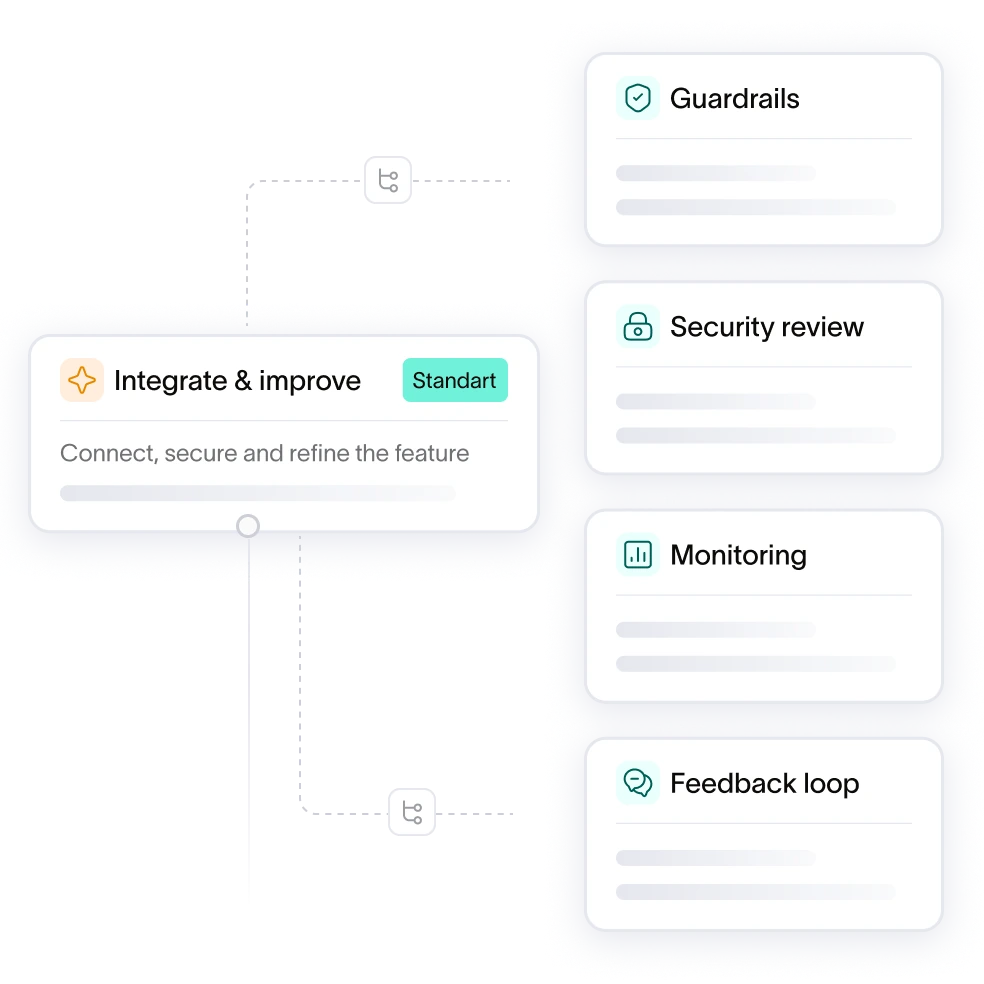
We connect the feature to the product, add the guardrails, security review and human review needed for production use, and refine it based on how real users actually interact with it.

We add

  • Guardrails for when the model gets it wrong
  • Security and data-handling review, including third-party testing for fintech and other sensitive data
  • Monitoring to catch drift or degraded performance
  • A feedback loop from real usage back into the feature
Integrate & improve diagram: connecting, securing and refining the feature — guardrails, security review, monitoring, and feedback loop

Validate the value first. Then build for real usage.

STEP

01

Identify the right opportunity

We look for repetitive manual work, unused product data, or moments where users need faster or smarter support: the same patterns that separate a real opportunity from a generic AI feature.

We look for

  • Repetitive manual work with a clear, learnable pattern
  • Product data that already exists but isn't being used
  • Moments where users visibly struggle or ask for help
MVP delivery flow: scope definition, design phase and development leading to a first release

STEP

02

Prototype and evaluate

We build a working version and test it against realistic inputs, checking accuracy, latency, and how often and how badly it gets things wrong, not just whether it works in a demo.

We test

  • Accuracy and consistency across realistic inputs
  • Response time and cost at expected usage volume
  • How clearly the feature communicates uncertainty or limits
Product foundation dashboard: production app with 24.8K active users, optimized architecture at 99% coverage, backend at 99.98% uptime and 12 active integrations

STEP

03

Integrate and improve

We connect the feature to the product, add the guardrails, security review and human review needed for production use, and refine it based on how real users actually interact with it.

We add

  • Guardrails for when the model gets it wrong
  • Security and data-handling review, including third-party testing for fintech and other sensitive data
  • Monitoring to catch drift or degraded performance
  • A feedback loop from real usage back into the feature
Dedicated team diagram: product management covering strategy, backlog and delivery alongside design and engineering covering UX/UI, frontend and backend

What you leave with

Not a disconnected prototype — a validated, production-ready AI capability, plus the safeguards and visibility needed to trust it in real use.

A prioritised AI opportunity icon

A prioritised AI opportunity

A prioritised AI opportunity

A clear, evidence-based case for where AI creates real value in your product, not just a list of ideas.

A validated use case icon

A validated use case

A validated use case

Confirmation that the opportunity solves a real problem, with the data and technical feasibility to support it, before development begins.

A production-ready AI feature icon

A production-ready AI feature

A production-ready AI feature

A working capability tested against realistic inputs and integrated into your product, not a standalone demo.

Guardrails and monitoring icon

Guardrails and monitoring

Guardrails and monitoring

Safeguards for when the model gets it wrong, and visibility into how the feature performs at real usage volume.

Integration with the right AI services icon

Integration with the right AI services

Integration with the right AI services

The model, API and infrastructure connections needed to run the feature reliably, chosen for the use case, not locked into a single provider.

A clear next-stage roadmap icon

A clear next-stage roadmap

A clear next-stage roadmap

A prioritised view of what to refine or expand next, based on real usage and feedback.

Selected product work

Selected product work

How AI creates measurable value inside a real product — not as a separate experiment, but built into how the product already works.

View all case studies

Frequently
asked questions

Answers to the questions that usually come up before starting an AI & product intelligence engagement.

How do we know if we have a good AI use case?

We help you find out — that's part of the engagement, not a prerequisite for starting it. We evaluate potential opportunities against user value, business impact, data readiness and technical feasibility before recommending anything to build.

What if we're not sure AI is the right solution?

That's a normal starting point. Part of our process is determining whether AI is actually the best way to solve the problem: sometimes a simpler, rule-based solution works better and costs less to maintain.

Do we need clean, structured data to start?

Not necessarily. We assess what data you already have and identify what needs cleanup, structuring or a retrieval layer before it can support an AI feature reliably. This is part of the evaluation, not a blocker to it.

Which AI models or providers do you work with?

We choose the model, API and infrastructure based on the specific use case, such as cost, accuracy, latency and data requirements, rather than defaulting to a single provider.

How do you handle cases where the AI gets something wrong?

Every feature we ship includes guardrails, monitoring and, where needed, human review, designed around how wrong answers could affect your users or business, not as an afterthought.

Can you add AI to a product you didn't build?

Yes. We review the existing product, architecture and data before recommending an AI feature, and design the integration to fit what's already there.

How long does an AI engagement take?

It depends on the complexity of the use case, the state of the underlying data, and the level of accuracy the feature requires. We define the expected stages and timeline after the opportunity is validated.

How do you keep AI features secure, especially with fintech or sensitive data?

Security is part of the design, not a step added at the end. Access controls, data handling and guardrails are built in from the start, and for fintech and other sensitive use cases we commission third-party penetration testing before the feature goes live.

Next in the Product Ladder

Build with a team that understands your business deeply

We stay involved as a long-term partner, helping you plan, prioritize, build, maintain, optimize, and evolve the product.

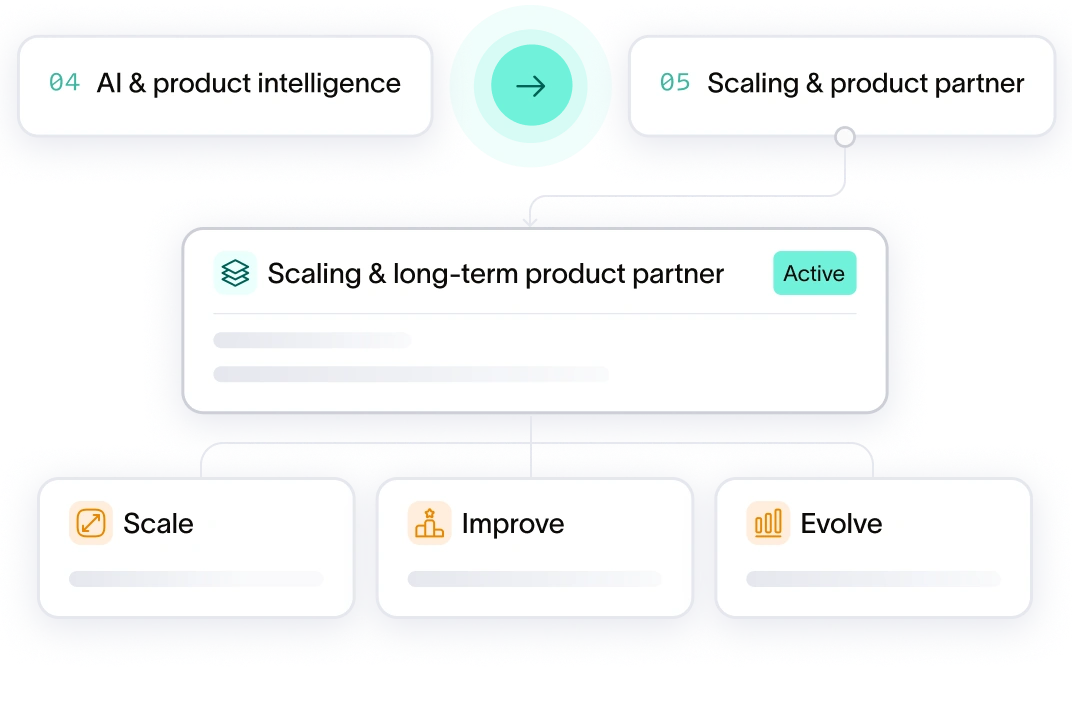
Mockup card promoting the next step: Scaling & Long-term Partnership

Ready to find where AI actually creates value?

Ready to find where AI actually creates value?

Let's look at your product, your data and your workflows — and identify the AI opportunities worth validating before you invest in building them, with the security fintech and complex products require.

Book a strategy call