Product Foundation

Turn the MVP into a stable, fintech-grade product

We improve architecture, user flows, backend structure, integrations, analytics, and deployment processes so the product can support real users and business operations. A senior, AI-enabled team means these improvements land fast and hold up under real complexity, not just in a demo.

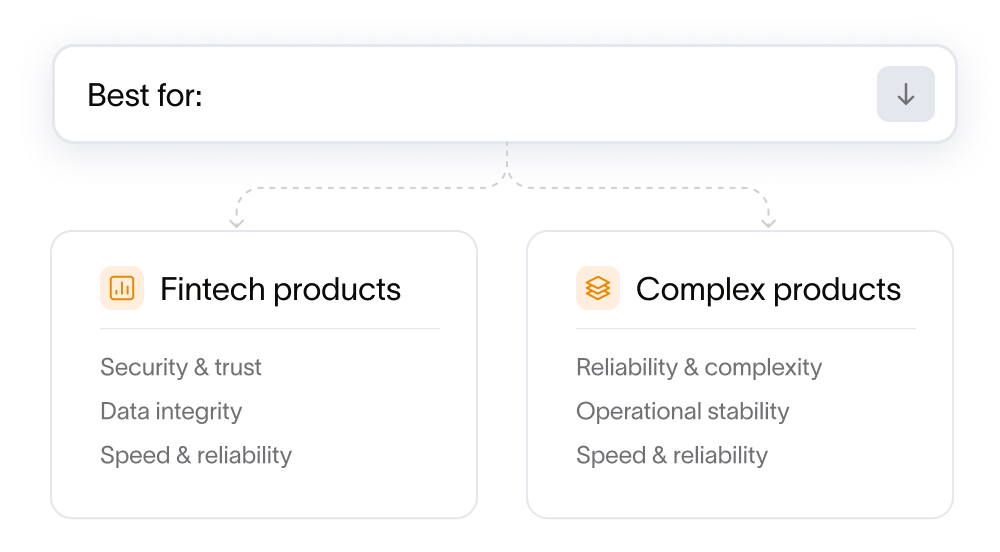
Mockup card showing who MVP development is best for: fintech startups, complex digital products, and early-stage founders

Your MVP works.
But it is starting to hold the product back.

Early product decisions help teams launch and learn quickly. Once the product starts supporting real users and business operations, those same shortcuts can create friction, risk and slower delivery.

Every release creates new issues

Every release creates new issues

Changes in one part of the product unexpectedly affect another, making releases slower and harder to predict.

Manual work keeps growing

Manual work keeps growing

Disconnected tools, missing integrations, and operational workarounds take more time as usage increases.

Growth exposes reliability gaps

Growth exposes reliability gaps

More users, transactions, or data reveal performance, stability, and security issues that were not visible during the MVP stage.

An MVP proves the direction. A foundation makes it last.

We keep what works, strengthen what matters, and evolve what was built for launch into what's built for growth.

MVP stage icon: built to learn

MVP stage

Built to learn

Focused first-release scope

Fast validation of key assumptions

Essential user journeys

Early product and technical decisions

Manual processes supporting early operations

Speed prioritised, with structure planned for the next stage

Product foundation icon: built to operate and evolve

Product foundation

Built to operate and evolve

Consistent product logic and user experience

Reliable business-critical journeys

Maintainable architecture and backend structure

Connected integrations and operational workflows

Useful analytics, monitoring and product visibility

Repeatable testing, deployment and release processes — automated testing, CI/CD pipelines and security testing built in
How we get there, stage by stage

We strengthen the product in focused stages — starting with the areas that create the most risk or friction, then improving the product, technical and delivery foundations without stopping ongoing progress.

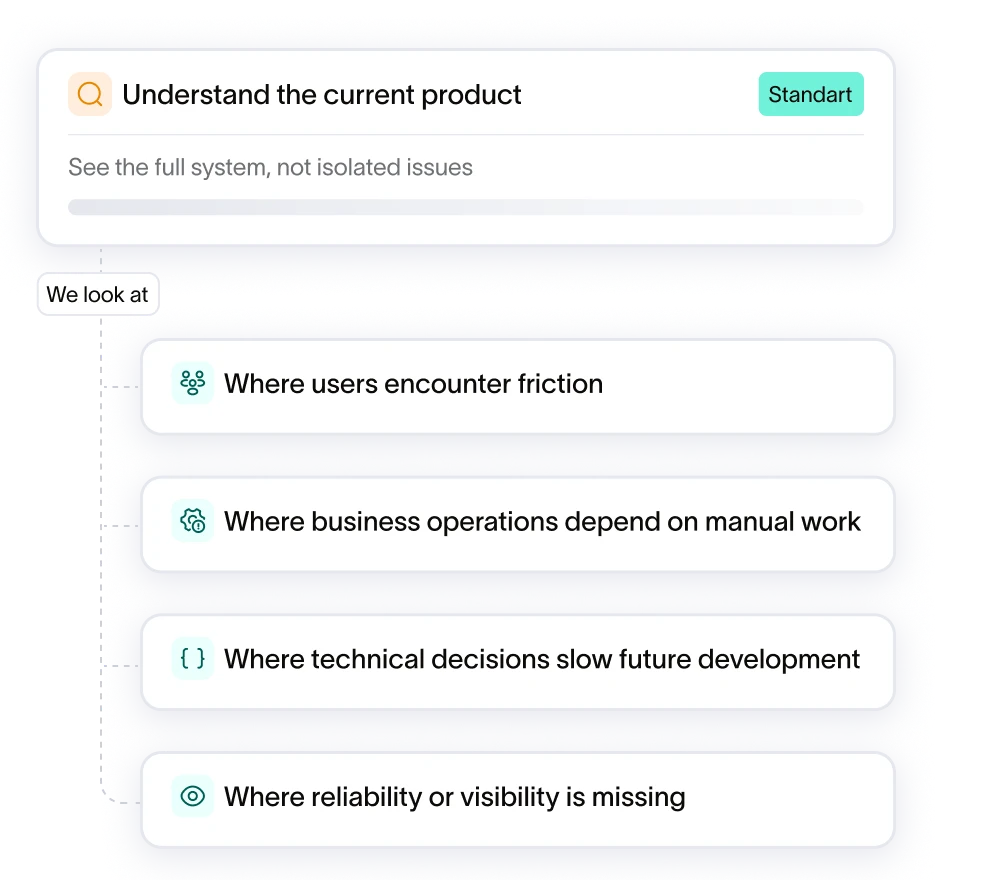
Understand the current product

See the full system, not isolated issues

We review the product experience, business logic, architecture, integrations, data flows and release process to understand how the product actually operates today.

We look at

  • Where users encounter friction
  • Where business operations depend on manual work
  • Where technical decisions slow future development
  • Where reliability or visibility is missing
Understand the current product diagram: seeing the full system, not isolated issues — where users encounter friction, where business operations depend on manual work, where technical decisions slow future development, and where reliability or visibility is missing

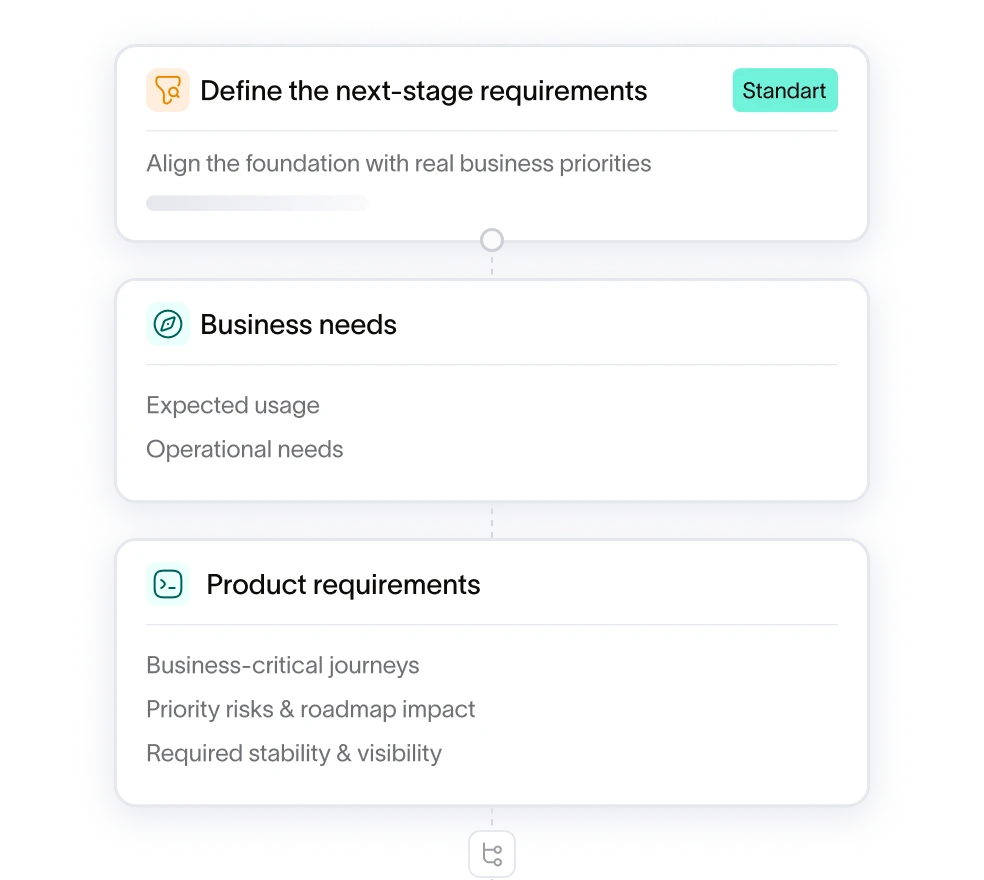
Define the next-stage requirements

Align the foundation with real business priorities

We connect product and technical decisions to the next stage of the business, such as expected usage, operational needs, roadmap priorities and the level of reliability the product now requires.

We decide

  • Which journeys are business-critical
  • Which risks need attention first
  • Which upcoming plans affect the product structure
  • What level of stability and visibility is now necessary
Define the next-stage requirements diagram: aligning the foundation with real business priorities — business needs (expected usage, operational needs) and product requirements (business-critical journeys, priority risks & roadmap impact, required stability & visibility)

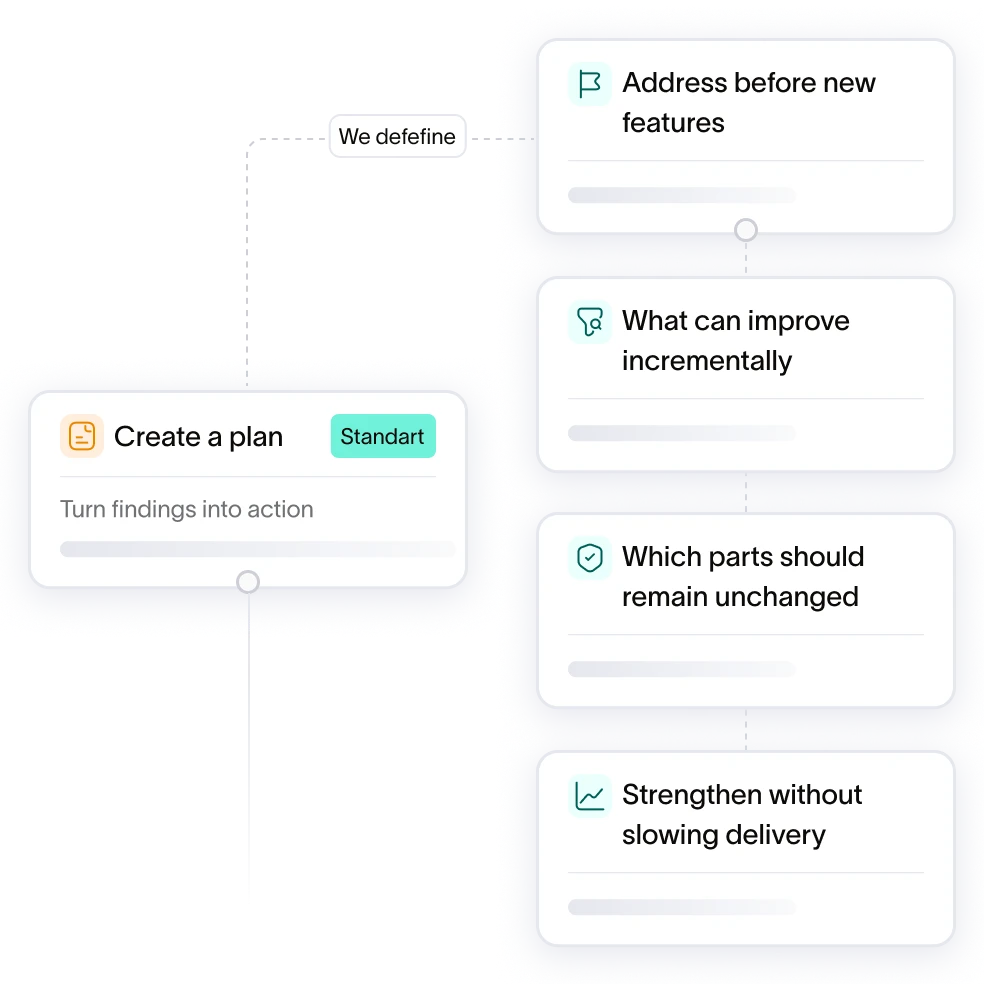
Create a focused improvement plan

Turn findings into a practical sequence of work

We prioritise improvements by user impact, business risk and implementation dependency, not by creating a long, disconnected backlog.

We define

  • What should be addressed before new features
  • What can improve incrementally
  • Which parts should remain unchanged
  • How to strengthen the product without slowing delivery
Create a plan diagram: turning findings into action — what to address before new features, what can improve incrementally, which parts should remain unchanged, and how to strengthen without slowing delivery

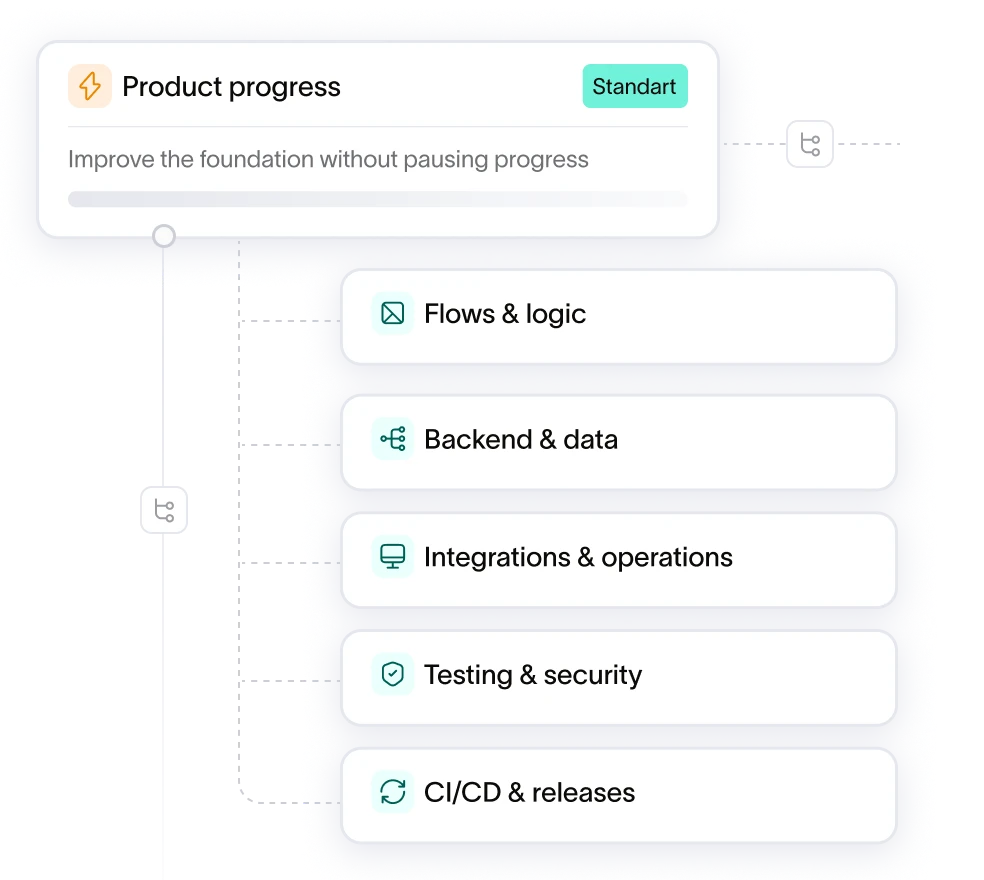
Strengthen the product

Improve the foundation without pausing product progress

Product, design and engineering work together across the selected journeys and system areas, releasing improvements in manageable increments.

The work may include

  • Improving core product flows and business logic
  • Refactoring backend or data structures
  • Strengthening integrations and operational workflows
  • Adding automated testing, monitoring and security testing, including third-party penetration testing
  • Setting up or improving CI/CD pipelines for predictable releases
Product progress diagram: improving the foundation without pausing progress — flows & logic, backend & data, integrations & operations, testing & security, and CI/CD & releases

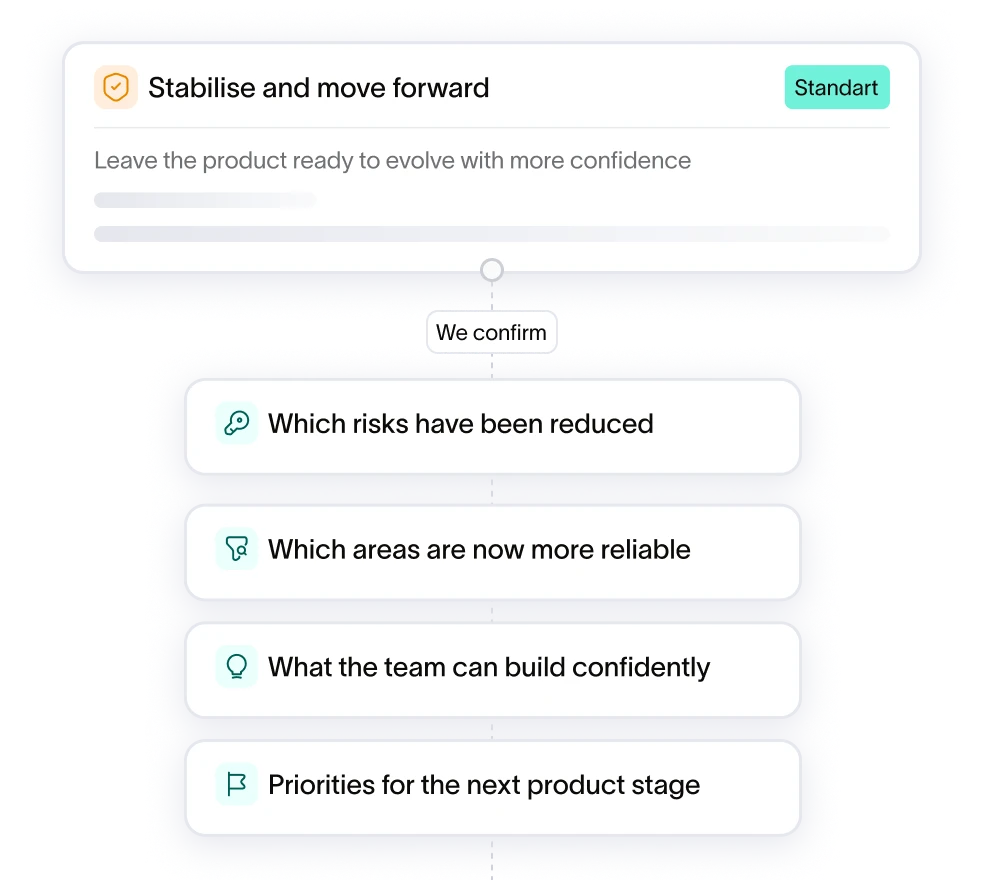
Stabilise and move forward

Leave the product ready to evolve with more confidence

We validate the improvements in real conditions, document important decisions and establish the foundation the team needs for continued development.

We confirm

  • Which risks have been reduced
  • Which areas are now more reliable
  • What the team can build more confidently
  • Which priorities belong to the next product stage
Stabilise and move forward diagram: leaving the product ready to evolve with more confidence — which risks have been reduced, which areas are now more reliable, what the team can build confidently, and priorities for the next product stage

How we get there, stage by stage

STEP

01

Understand the current product

See the full system, not isolated issues

We review the product experience, business logic, architecture, integrations, data flows and release process to understand how the product actually operates today.

We look at

  • Where users encounter friction
  • Where business operations depend on manual work
  • Where technical decisions slow future development
  • Where reliability or visibility is missing
MVP delivery flow: scope definition, design phase and development leading to a first release

STEP

02

Define the next-stage requirements

Align the foundation with real business priorities

We connect product and technical decisions to the next stage of the business, such as expected usage, operational needs, roadmap priorities and the level of reliability the product now requires.

We decide

  • Which journeys are business-critical
  • Which risks need attention first
  • Which upcoming plans affect the product structure
  • What level of stability and visibility is now necessary
Product foundation dashboard: production app with 24.8K active users, optimized architecture at 99% coverage, backend at 99.98% uptime and 12 active integrations

STEP

03

Create a focused improvement plan

Turn findings into a practical sequence of work

We prioritise improvements by user impact, business risk and implementation dependency, not by creating a long, disconnected backlog.

We define

  • What should be addressed before new features
  • What can improve incrementally
  • Which parts should remain unchanged
  • How to strengthen the product without slowing delivery
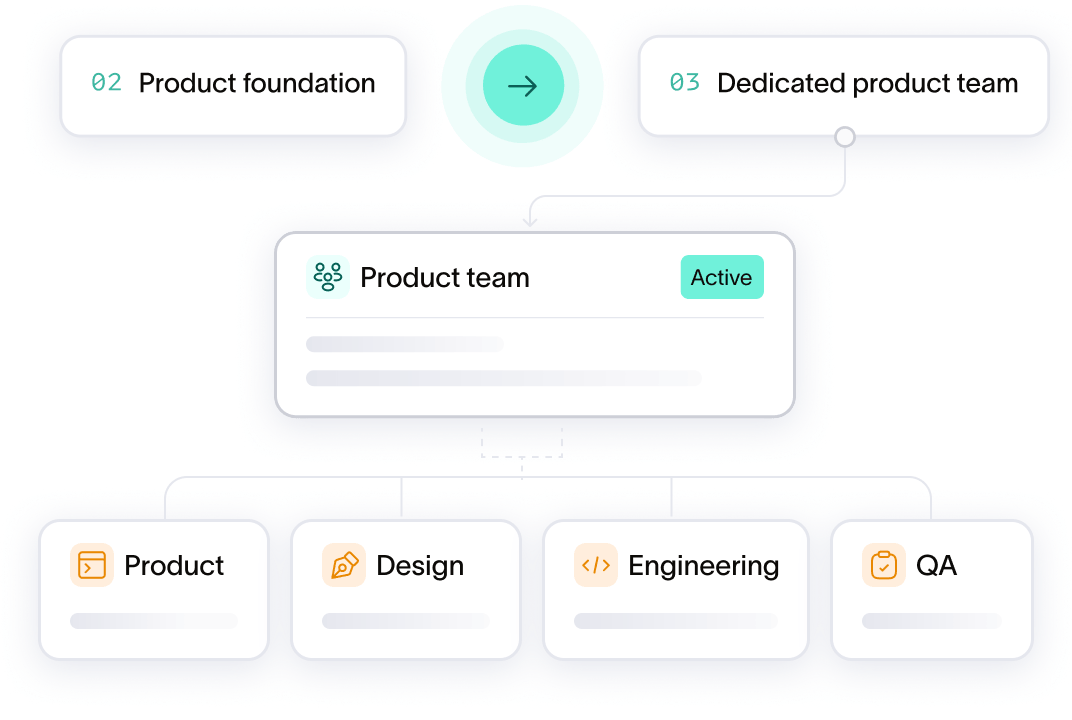
Dedicated team diagram: product management covering strategy, backlog and delivery alongside design and engineering covering UX/UI, frontend and backend

STEP

04

Strengthen the product

Improve the foundation without pausing product progress

Product, design and engineering work together across the selected journeys and system areas, releasing improvements in manageable increments.

The work may include

  • Improving core product flows and business logic
  • Refactoring backend or data structures
  • Strengthening integrations and operational workflows
  • Adding automated testing, monitoring and security testing, including third-party penetration testing
  • Setting up or improving CI/CD pipelines for predictable releases
AI layer diagram connecting smart assistants, data insights, automation, new capabilities and knowledge and data

STEP

05

Stabilise and move forward

Leave the product ready to evolve with more confidence

We validate the improvements in real conditions, document important decisions and establish the foundation the team needs for continued development.

We confirm

  • Which risks have been reduced
  • Which areas are now more reliable
  • What the team can build more confidently
  • Which priorities belong to the next product stage
Long-term partnership diagram: a strategic roadmap covering new features, optimization, scaling and maintenance

What you leave with

Together, these outcomes give the team a foundation built for reliability, visibility and continued growth.

Consistent product logic icon

Consistent product logic

Consistent product logic

Core journeys, business rules and product states that work as one coherent system.

A reliable technical foundation icon

A reliable technical foundation

A reliable technical foundation

Architecture and data structures built to support reliability and future development.

Connected operations icon

Connected operations

Connected operations

Integrations and internal workflows that remove growing manual work.

Product visibility icon

Product visibility

Product visibility

Analytics and monitoring that show how the product actually performs.

Safer releases icon

Safer releases

Safer releases

Automated testing, CI/CD and security checks — including third-party penetration testing before release — making changes predictable.

A clear next-stage roadmap icon

A clear next-stage roadmap

A clear next-stage roadmap

A prioritised, dependency-aware plan for what to strengthen next.

Selected product work

Selected product work

Every Product Foundation engagement is different, but the goal is always the same: strengthen what's already working and prepare the product for real, sustained growth.

View all case studies

Frequently
asked questions

Answers to the questions that usually come up before starting a product foundation engagement.

How do we know if our MVP is ready for product foundation?

Product foundation is usually the right next step when the MVP has validated its core direction, but real usage is exposing limitations in user flows, product logic, integrations, architecture or delivery processes.

Do you need to rebuild the entire product?

No. We first identify what already works and should remain unchanged. We then focus on the areas that create the most risk, operational friction or limitations for continued product development.

Are you limited to a specific tech stack?

No. We review your existing stack and architecture first, and work within it wherever practical. If a specific technology is genuinely limiting the product's reliability or growth, we'll flag it as part of the assessment, not assume a change is needed by default.

Can we continue releasing features during the engagement?

Yes. We plan the foundation work in focused increments so the product can continue moving forward while the most important structural issues are addressed.

What does the engagement include?

The scope may include core user flows, product logic, backend structure, data flows, integrations, analytics, monitoring, testing and deployment processes. The exact priorities depend on the current product and its next-stage requirements.

What will we have at the end?

You will have a stronger working product, implemented foundation improvements and a clear view of the remaining priorities for continued development.

How long does product foundation take?

The timeline depends on the condition of the existing product, the complexity of its systems and the priorities we agree to address. We define the expected stages and milestones after reviewing the current foundation.

How is the budget defined?

The budget depends on the current state of the product, the scope of improvements needed, and the technical complexity involved. We assess the existing foundation first, then define priorities and investment together.

What do you need from our team?

Access to the current codebase, relevant technical documentation, and key people who understand how the product works today. Your team reviews priorities and key decisions — Base Blocks manages day-to-day delivery, with a senior, AI-enabled team so improvements move quickly without cutting corners on reliability.

How do you handle security?

Security testing is part of the process, not an afterthought. Alongside automated and manual testing, we commission third-party penetration testing before release on fintech and other sensitive products, so the product is validated by an independent party, not just our own team.

Next in the Product Ladder

Get a stable team that owns product delivery

We provide a dedicated team covering product management, UX/UI, frontend, backend, mobile, and QA depending on your needs.

Mockup card promoting the next step: Dedicated Product Team

Ready to turn your MVP into a stable product?

Ready to turn your MVP into a stable product?

Let's discuss where the current product is creating friction, risk or slower delivery — and define the focused improvements needed to support real users, business operations and continued growth, delivered by a senior, AI-enabled team with real fintech and complex-product experience.

Book a strategy call