
Back to blog
Build vs. buy in 2026: why fintechs are replacing expensive SaaS with custom in-house tools
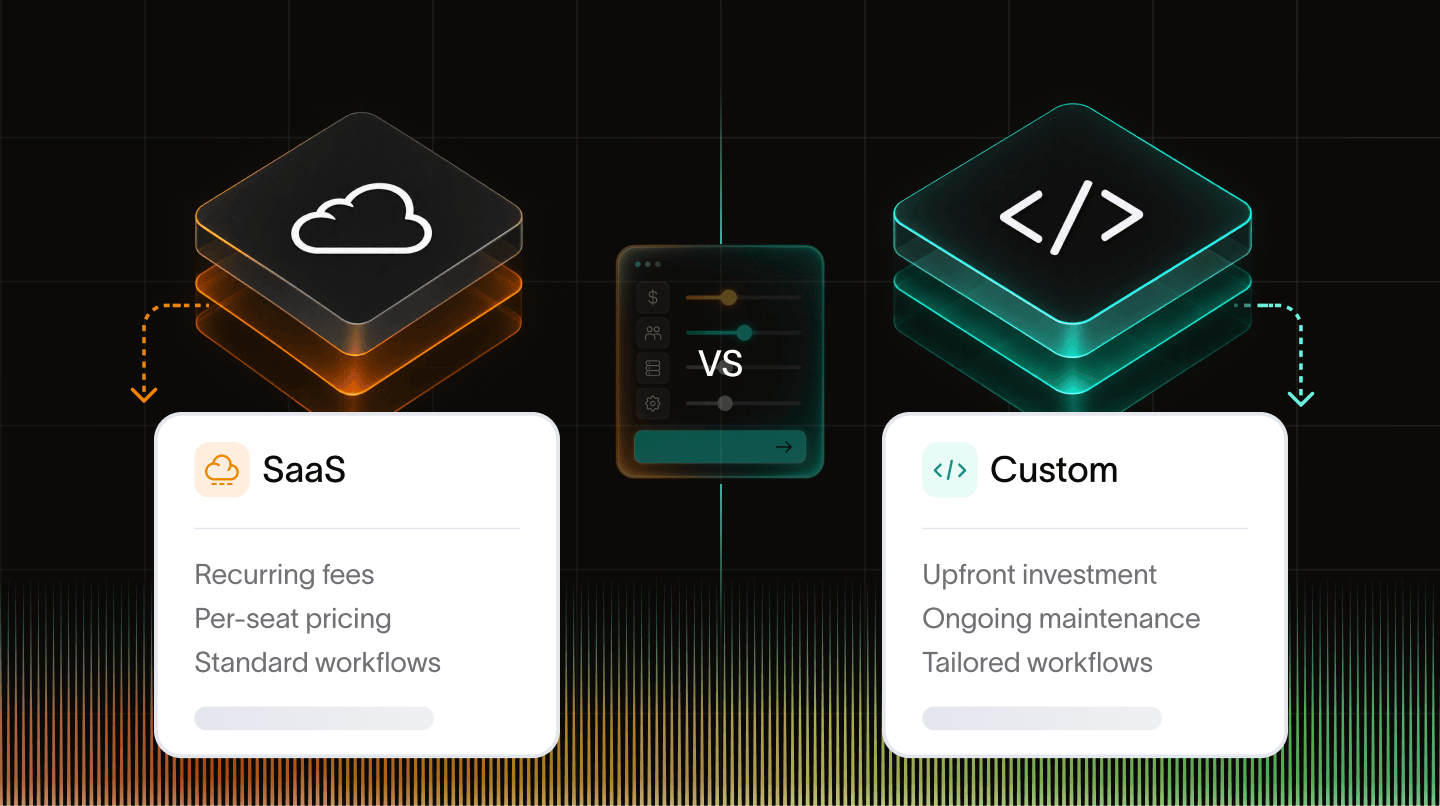

For most of the last decade, build vs. buy had a default answer. Buy. Engineering time was the scarcest resource in the company, SaaS was cheap relative to salaries, and any month spent building an internal tool was a month not spent on the product customers pay for.
That reasoning was correct. It's now partially out of date, and the reason is cost. AI-assisted development has meaningfully lowered what it takes to build and maintain a well-scoped internal tool. At the same time, SaaS pricing has gone the other direction, with per-seat costs, usage tiers, and annual increases that compound as you grow.
The line between build and buy hasn't disappeared. It has moved. Some tools that were obviously worth buying in 2020 are now worth a serious second look.
What actually changed
Three things, none of which are "AI writes your software for you."
Development got cheaper for a specific class of work. AI tooling handles roughly 30 to 40% of code in practice, concentrated in exactly the kind of work an internal tool consists of: CRUD interfaces, data transformations, integration glue, admin dashboards, reporting. It performs far less well on novel, high-complexity problems. That asymmetry is the whole story. The cost of building the boring 80% of an internal tool fell. The cost of building genuinely hard software did not.
SaaS costs scale with your growth, and builds don't. A $40-per-seat tool is trivial at 15 people and a real line item at 150. Custom software has the opposite shape: heavy up front, then maintenance. Somewhere between those two curves is a crossover point, and headcount growth moves you toward it whether you're paying attention or not.
Off-the-shelf tools force process compromises that cost real money in fintech. Most fintech operations teams run at least one workflow that doesn't map cleanly onto any product on the market. What follows is a spreadsheet bridging two systems, a manual reconciliation step, or a person re-keying data between tools. That workaround has a salary attached to it, and it rarely shows up in the SaaS cost comparison.
The honest case for buying
Before the framework, the counterweight, because the "replace your SaaS" argument gets oversold.
Buying is still correct for anything where the vendor's core competence is the product itself, and where being wrong is expensive. Identity verification is the clearest example. On a recent investment platform build, we integrated a specialist KYC provider rather than building verification ourselves, because regulated identity verification is a mature category with years of investment behind it, and a custom build would have been slower, weaker, and harder to defend to an auditor. The product work was everything around the vendor: where verification fires in the user journey, the internal review dashboard, the status UI. That's the right division of labor.
The same logic applies to payment processing, accounting systems, core banking infrastructure, email delivery, and anything where compliance certification is part of what you're buying. You are not going to out-build Stripe, and you shouldn't want to.
Buying is also right when the tool isn't close to your differentiation, when the vendor's roadmap is genuinely doing work for you, and when the total cost is small enough that the comparison isn't worth the meeting.
The four things that actually decide it
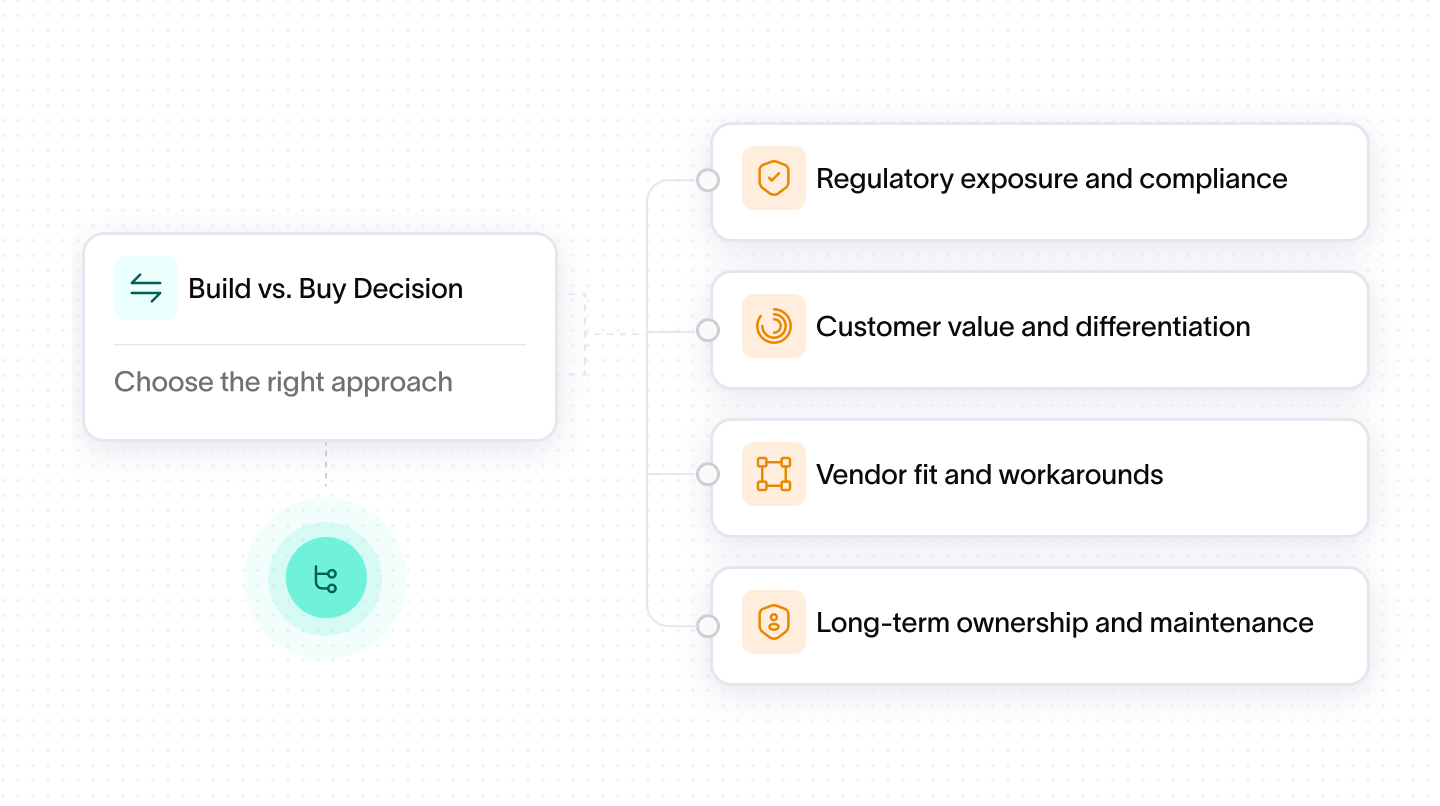
Strip away the specifics of any individual tool and the decision comes down to four dimensions, which don't carry equal weight.
Regulatory exposure, which works as a gate rather than a factor. If the vendor's value includes compliance certifications, licences, or the liability attached to them, the decision is already made and the other three dimensions don't get a vote. Payment rails, KYC/AML verification, and core financial infrastructure sit here.
Differentiation. Not "is this important" but "would customers notice or care if we did this differently from the generic version?" Undifferentiated infrastructure gets bought even when it's mission critical.
Vendor fit. Whether a product exists that matches the need directly, rather than as a side feature of something broader, and how much manual workaround you'd still be doing with the closest available option.
Ownership. The question that sinks most build decisions after the fact. An internal tool with no named owner degrades quietly, and by the time it fails, the institutional knowledge to fix it has left. If you can't name the person or team responsible eighteen months out, that alone should pull you toward buying.
Underneath all four sits the economics, which is the part teams most often get wrong by instinct. Both sides get underestimated in opposite directions: the SaaS side gets costed as a licence fee rather than licence plus integration plus the salary cost of the workarounds it forces, and the build side gets costed as a project rather than a project plus years of maintenance and on-call.
That part needs real numbers, not judgment. So we built a tool for it.
Run your own numbers
Our Build vs. Buy Calculator works through the four dimensions above and does the economics properly: your current SaaS cost and expected headcount growth against a build estimate and its maintenance load, producing a three-year total for each path and the crossover point in months.
It takes about 90 seconds, and the verdict comes back without asking for an email. If you want the full cost breakdown to take into a renewal conversation, you can have that emailed to you.
Worth saying explicitly: it returns "buy" often. A calculator built by a development agency that always recommended building would be a sales form wearing a calculator's clothes, and any CTO would spot it on the first run.
Where building tends to win in fintech
Patterns we see most often, all of which share the same shape. Well-defined logic, deep coupling to how the business specifically works, and no vendor that fits without compromise:
- Internal ops and back-office tooling. Review queues, approval workflows, and case management built around your actual process, not a generic one.
- Reconciliation between systems that don't integrate. Often the single most expensive manual workflow in a fintech company, and usually one nobody sells a product for because it's specific to your combination of systems.
- Reporting and analytics for a specific business model. Generic BI tools handle generic questions. The metrics that actually run the business tend to need custom work.
- Workflow automation across several tools. The glue layer holding your stack together is by definition not something anyone sells.
- Customer-facing features that a vendor widget makes generic. Anywhere an embedded third-party UI makes your product feel like everyone else's.
Where building usually loses
Equally worth naming. Building tends to be the wrong call for payment processing, identity verification and AML screening, core accounting, email and notification delivery, and anything requiring a certification you'd have to obtain and maintain yourself.
There's also a category worth flagging: tools you're tempted to build because the vendor's pricing annoys you. Irritation isn't a business case. Run the three-year numbers, and if buying still wins, keep buying and negotiate harder.
A reasonable way to start
Rather than auditing the whole stack, pick the single tool where you're paying the most and getting the least, and run that one through properly. One well-chosen comparison teaches you more about where your own crossover point sits than a spreadsheet full of estimates for tools you were never going to replace.
Be honest with yourself about what a build commits you to, too. Software you own is software you maintain. That's a fair trade when the tool is close to your business and the numbers work, and a bad one when you're mostly just annoyed at a renewal quote.
Where Base Blocks fits
We build custom internal platforms and product features for fintech and other complex products, using AI throughout our own delivery process so the work lands faster than it would have a few years ago. We'll also tell you when the answer is to keep buying, because half the value in this decision is knowing which side of the line something falls on.
The short version of the framework: regulated or certified capabilities get bought, undifferentiated infrastructure gets bought, and building earns its place when the process is specific to how your business works, no vendor fits it without manual workarounds, the three-year numbers favour it, and you can name who will own it. Run your tool through the Build vs. Buy Calculator to see where yours lands, or book a strategy call if you'd rather work through it with us directly.
October 21, 2026


